Sue Schardt, Executive Director of AIR, and Jessica Clark, director of the Center for Social Media’s Future of Public Media project, just published this report on the impact of MQ2, featuring a detailed analysis of Mapping Main Street. Read it here:
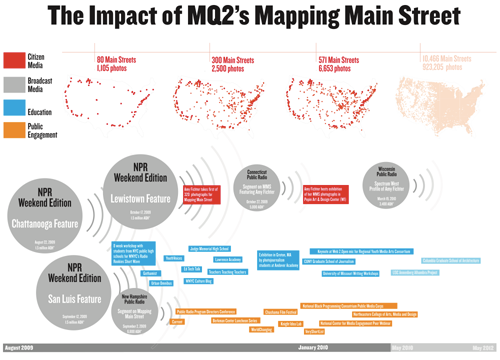
Included is an infographic demonstrating the ways in which MMS has extended far beyond the initial NPR broadcasts, taking on a life of its own and illustrating a new paradigm for multiplatform public media.
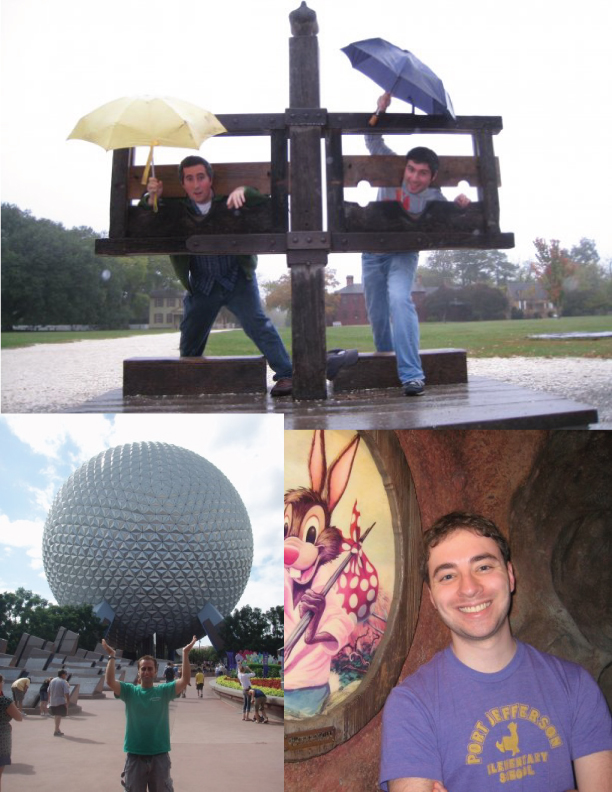
In the winter of 2010, a reunion of four high school friends occurred in the Village of Port Jefferson to document the place of their youth.All founders of Silly Hats Only Productions, they made their way up and down Main Street, visiting the shops, clientele, and business owners that bring life to the Village every day.Along the way they shared conversations with a village guide, the mayor, the owner of a sea shell store, an arts director at the local theatre, and more.
The four of us have a yearly tradition of coming together over our respective winter breaks to shoot short films as a creative outlet.This year, we decided to put our efforts towards a Mapping Main Street contribution, since we felt our beloved hometown, with its combination of history and unique small businesses, had a story worth telling.What we didn’t account for during the shoot were the gusts of wind, quickly dropping temperatures, and the icy water kicking up on shore by the town’s ferry.Our only regret in putting this short film together is that we couldn’t share every part of our Village, from the downtown bar regulars to the line cook at the local steakhouse.There’s a richness in character on this Main Street that must be experienced in person.
- Adam Gismondi, Luke Ceo, Mark Sternberg and Ryan Hodum
Mark Sternberg, Luke Ceo, Adam Gismondi and Ryan Hodum of Port Jefferson, NY
Downtown Durham, North Carolina is filled with old tobacco warehouses, more and more of them now being converted into hip lofts, offices, and retail shops. Durham’s renaissance has come slowly, and only after decades of dormancy. Native son Gayford Caston has a small shoe repair shop on Main Street. He’s open 7 days a week. When he’s not fixing torn leather on his old Singer sewing machine, replacing worn soles on his shoe jack, or erasing black marks on scuffed boots, Caston loves to chat, and reminisce about the old Durham, with his customers.
Amy Fichter uses her iPhone and an antique twin lens reflex camera to capture surprising images of Main Streets throughout Wisconsin.
Her exploration, inspired by Mapping Main Street, has given her new insight into her own art and community: “Through working on this project I have learned more about who my neighbors are, what they care about, and how they identify themselves. I have learned about the history of these people and places. I have been surprised at the treasures I find.”
Jesse and Kara caught up with Urban Omnibus to talk about how Mapping Main Street got started and the possibilities of using collaborative documentary as a tool for urban planning. Urban Omnibus is a dynamic website connecting journalists, architects, planners, designers, artist, activists, scholars and citizens all seeking to create a new kind of conversation about design and New York City.
See how the creative gears came together to bring Mapping Main Street to life, as Kara, Jesse and James share their insights and inspirations at the Berkman Center for Internet & Society lunch seminar.
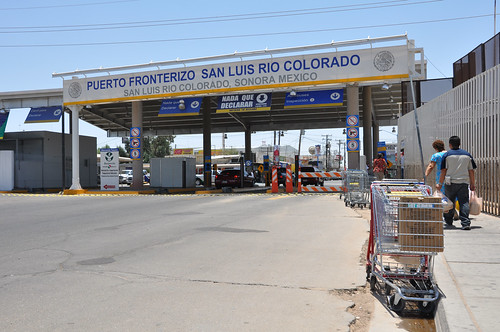
The end of Main Street in San Luis, Ariz., is a border crossing station that connects the city to San Luis Rio Colorado in Mexico.
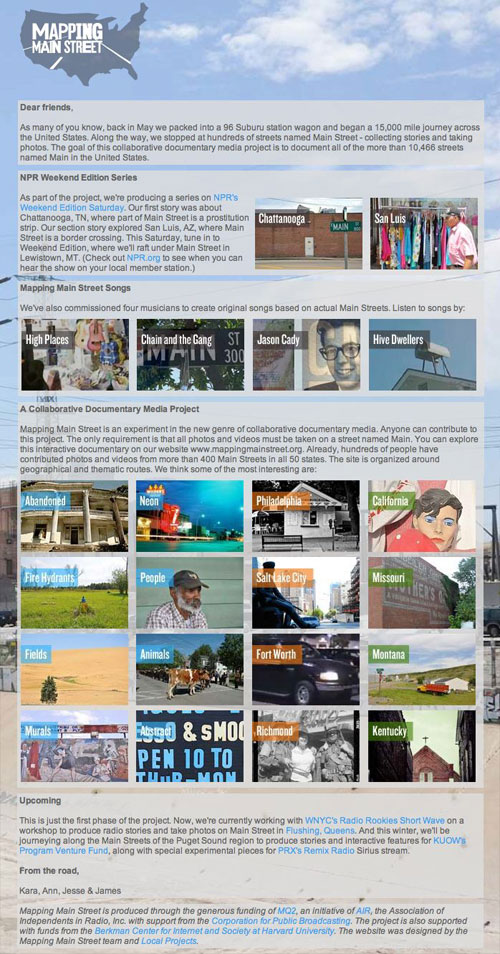
Our second story in the series airs today on NPR’s Weekend Edition Saturday. It is about Main Street in San Luis, Arizona, which runs straight into the border with Mexico. Listen to it on NPR’s website.
Wondering how Mapping Main Street came to be? Turns out it’s one part lots of hard work, plus one great opportunity, add several friends and colleagues to guide you, plus creative problem solving and you get something much larger than you could ever hope for, something 10,466 streets large.
You can learn even more about the public radio system and other exciting creative media projects in this article from Current-the newspaper about public TV and radio in the US.
Where can you inner-tube through snake infested waters directly under a local bar? Ann Heppermann and Kara Oehler share with New Hampshire Public Radio’s Word of Mouth what it’s like to wade in the sometimes mysterious and exciting waters of radio production.
The first story of the series – “In Chattanooga, Main St. Is A Prostitution Strip” – aired today on NPR’s Weekend Edition Saturday.
On the surface, Main Street in Chattanooga, Tenn., looks nice. There’s a newly developed arts district with galleries, upscale restaurants, a packed breakfast joint called the Bluegrass Grill, even houses that have been certified as environmentally friendly. But if you stray from these newly renovated blocks, there’s a different side to Chattanooga’s Main Street.
“In Chattanooga, we have this underbelly,” Brother Ron Fender says. “You can walk down Main Street, and you don’t know that just over there, there’s prostitutes — or just over there is a camp where people sleep in the woods at night.”
Listen on NPR’s site, watch the video above or click on the Chattnooga feature in the gallery to see it within the Tennessee route.
Kara and I had collaborated with composer Jason Cady on the sound installation “Chorus of Refuge” where he pitch shifted and combined the voices of six refuges into one choral work (for six radios). We loved it and wanted to work with him again. We found out his father lived off of a Main Street near his hometown of Flint, Michigan. His father worked on the assembly lines at General Motors.
Below, Cady describes how he took the three-hour oral history of his father and transformed it into ‘Generative Monologue.”
Generative Monologue
I composed Generative Monologue for spoken voice, synthesizer, and field recordings.
1. The Voice:
My father, Dennis Cady, is a retired autoworker. He was born and raised in Flint, Michigan. He now lives on a street that turns into Main Street.
My father was born during World War II and his father died fighting in the Normandy invasion. His mother worked evenings and he was left alone to raise himself. Even before reaching adolescence he had already taken up smoking, drinking, shoplifting and hitchhiking.
His older sister was expelled from all the high schools in the area and eventually dropped out. My father, however, graduated from high school and attended Mott Community College while working at a gas station. His mother pressured him to withdraw from college so that he could work full time at one of the General Motors factories. So he applied for a job at Buick and was hired to work at a complex of factories called Buick City.
My father met my mother at Buick City where they worked along side each other on the assembly line. After they married she encouraged him to quit drinking, which he did. Years later he used subliminal tapes to quit smoking.
For the last ten years before my father retired he worked eighty hours a week. He won accolades and an award from Buick for the hard work and the long duration and consistency of his overtime.
After retiring he was diagnosed with cancer. He believes that it may have been caused by some of the chemicals that he was exposed to at his job. It has been four years since his last surgery and he is still recovering from the chemotherapy.
My father’s recollections and reflections on his life are the content of Generative Monologue. I chose to create this piece with his voice, not only because he is an engaging storyteller, but also because of the timbre, melody, and expressiveness of his bass voice.
2. The Music:
Generative Monologue begins in D minor, modulates to A minor and ends in D minor with the same basic material occurring in both the tonic and then transposed to the dominant. The harmonic progression that repeats and forms the core of the piece is:
D- Bb D-
A Bb dim A
A dim C7 A dim
B-7 G- A
This chord progression supports a mostly two-note melody of the pitches A and Bb, while the other notes of the harmonies descend chromatically by parallel minor thirds. I composed this melody and chord progression to fit the basic character of the story.
I performed the melody and chords on synthesizer. The voice “solos” on top of the synthesizer part with continuously changing material. I used pitch correction software to tune and quantize the voice. After tuning the voice to the chromatic scale I then adjusted the notes to fit with the harmonies. I always tried to manipulate the voice as little as possible to avoid digital artifacts from the software; usually I would just move the notes up or down a half step. In spite of that, the voice still came out sounding strange at various moments, though the oddness does, of course, contribute to the overall character of the piece.
I used pitch correction software on speaking voice previously for a sound installation — Chorus of Refuge — that I composed in collaboration with Ann Heppermann and Kara Oehler. In Chorus of Refuge there were six a cappella voices transmitted through radios simultaneously. For Generative Monologue I worked with the same process while focusing on only one voice, with instrumental and other sounds, for a homophonic texture instead of the polyphony of Chorus of Refuge.
3. The Background:
Along with the foreground voice and synthesizer I also included backing vocals and ambient tracks. The backing vocals are comprised of additional tape from interviews with my father. The ambient tracks are field recordings of the Flint River that were recorded behind my father’s house, which runs through Flint and along Main Street. I put all the background tracks through a vocoder using the same chords as the synthesizer tracks. This background layer enriches the texture by providing some more irregular sounds in contrast to the repetition and synthetic perfection of the foreground.
Recorded and mixed by Clay Holley, interviews and field recordings by Ann Heppermann
We asked Calvin Johnson of K to create a Main Street song about a town the northwest. Calvin traveled to Bucoda, Washington and walked around the Main Street. There, he met Mayor Pro Tem of Bucoda, Alan Carr. “A Kiss on Main Street” was based on their conversation and recorded with Calvin’s latest band, the Hive Dwellers.
Calvin wrote about his experience for Mapping Main Street:
Bucoda is located in the woods of southwestern Washington. Founded as a “company town” centered on coal mining and lumber, it was also the site of the first territorial prison. Originally it was known as Seatco until three local lumber Barons petitioned the Washington State Legislature to change the name to a new word comprised of the first two letters of their last names: Buckley, Coulter and Davis. When the lumber mills were operating at full bore, Bucoda was known as the “little town with the million dollar payroll”. The most visible historic structure on Main Street is the Odd Fellows Hall, built in the early ‘20s during the civic heyday. It is currently owned by the city, who have plans to renovate it to its former glory; donations toward this end are currently being accepted.
Seatco Prison closed when all its inmates were moved to the new state prison built in Walla Walla. The lumber mills have all burned or closed. The school district shut down in the ‘70s, students now travel to Tenino for their schooling. The local hotels, movie theaters, Ford dealership, all that, gone. Old highway 99 runs parallel to Main Street on the other side of the railroad tracks. With the advent of Interstate 5, it is no longer the main thoroughfare between Seattle, Wash. and Portland, Ore. The railroad tracks host Amtrak, but no passenger train has stopped in Bucoda for over 40 years. There are only 665 residents left in the town, and two businesses on Main Street, Joe’s Place, a restaurant and tavern, and Liberty Market, a general store.
Bucoda is not to be dismissed as another grim reminder of the death of Small Town America. A recent visit there revealed Bucoda to be lively, full of character. Lots of folks were out on the street, quick to extend a friendly greeting to an obvious stranger. Though development is limited until Bucoda’s septic and storm water systems are upgraded to current state standards, other utilities surpass many Washington communities several times its size: local telephone service provided by the Tenino Telephone Company features the most up-to-date communications technology available, making this the “small town with the million dollar high-speed connection”.
The annual school reunion the last weekend of July is being expanded next year to a centennial celebration, as 1910 was the year Bucoda officially incorporated. There will be a parade down Main Street, and placards around town identifying the locations of various businesses and historic residences. Plan your summer vacation around attending this event. It will be a party.
We asked Mary Pearson and Rob Barber of High Places to write a few words about how they came to write a Main Street song about Los Angeles. Here’s what they had to say:
Mary: Rob and I recently relocated from New York City to Los Angeles,
and consequently I felt a bit under-qualified at first for the role of
Los Angeles Main Street Representative. However, as I began to think
more about the task, it dawned on me that a newcomer can often see
aspects of her surroundings that are so commonplace as to go unnoticed
by longtime locals. Few born-and-raised Angelenos would treat wild
succulents and late night taco trucks with quite the degree of
reverence and gratitude Rob and I bestow upon such things. And it also
struck me that Los Angeles is largely defined by its Promise-Land-like
ability to lure in outsiders. In fact, this trait can be attributed to
the entire state of California.
Rob: As far as how we approached writing the song, this was the
perfect project for HighPlaces. Ordinarily, when we write for
ourselves, we make a lot of off-the-cuff recordings and then arrange
all the parts into a sort of hyper-organized mega-mix.
With “Main Street”, we first went out on a couple different occasions
to gather field recordings. Both times were very different from one
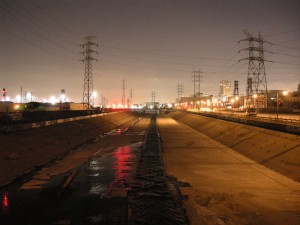
another. The first night we went down to a more deserted stretch near
the L.A. River, and recorded the more ambient aspects of the song. The
whoosh of distant cars driving over manholes, crickets and night bugs,
and the all-too-familiar (as well as surprisingly percussive) L.A.P.D.
helicopters equipped with spooky spotlights. These sounds were cut up
and used largely in the construction of the rhythm. A few days later
we attended a Saturday afternoon street fair, where we gathered much of
the rest of the sounds used: children playing, food frying, random
snippets of conversations, empanada street vendors shouting “How many
dozens?”, and of course a bunch of musicians whom we carefully worked
off of with our own instrumental parts to fill out the composition. It
was important to us to recreate a feeling of the multi-directional
overlap and interplay of sounds present in a busy street environment.
HighPlaces tours a lot. We see a lot of Main Streets. Main Street Los Angeles is, as with most Main Streets, totally unique and of itself. Although parts are rather deserted and empty, such as the region near the L.A. River, other parts just a few blocks away, still give the feeling of being historically one of L.A.’s predominant thoroughfares. Unlike many other Main Streets, which have become forgotten and obsolete with the development and commercialization of a town’s outlying areas, L.A. Main Street is still mostly a viable and important center of the city.
Like the spirit of California, it means different things for different people. For example, It contains the the oldest part of town, as well as the home of L.A.’s underground music scene, the Smell.
Mary: Joni Mitchell’s “California” is such a fitting love song to the elusive, golden state. The song is often what I sing at HighPlaces sound checks, and I felt I just had to pay tribute to it in this composition by borrowing the lyrics from the chorus, “California, oh California, I’m comin’ home…” Hopefully our composition was successful in creating a similar mood of nostalgia and promise.
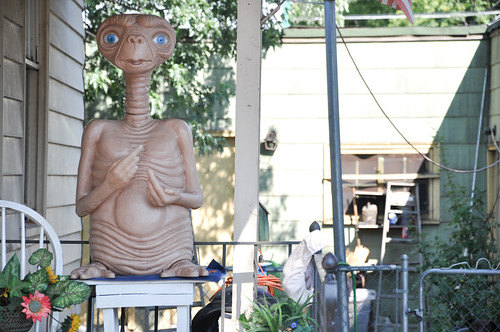
One of my favorite Main Street moments. I catch a glimpse of awesome E.T. sculpture on the porch right next to an intimidating sign advertising a strict shooting of visitors policy. After a few quick snaps, I see the blinds jostle. And then the door opens. I’m freaked.
Out comes a tall, lanky man. In a casual, friendly voice he says, “You like E.T.?” I reply, “Yeah. He’s great.” I tell him about the project and he says, “Wow. That is so cool. When can I hear everything on NPR?”
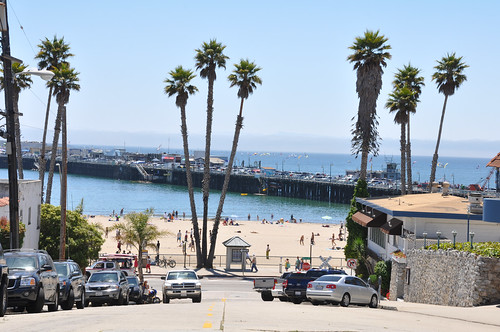
While walking down Santa Cruz’s 3 block Main Street, I noticed a guy standing next to a pick up truck holding a fishing pole. I asked him, “What do you catch out there?”
He said, “Mostly Striped Bass. I’m out here to take my girlfriend’s kids fishing.”
Then he put his hand on my shoulder, looked me in the eye and said, “But if you had caught me 5 years ago, I would have been out here sidewalkfishing.”
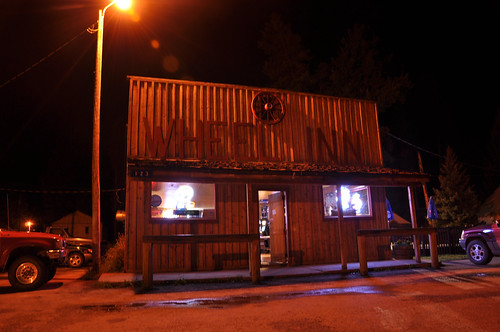
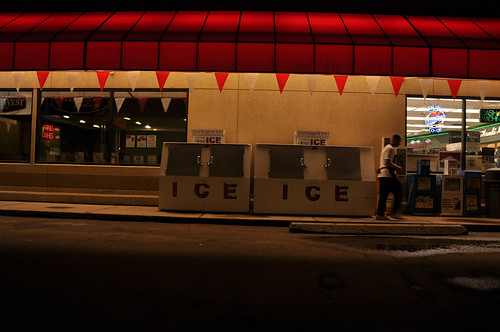
We’re on our way to see Ian, our Big Sky Producer. He said we had to stop in Lincoln, the town where the unabomber lived. The only people we saw were through the a propped-open bar door and a guy locking up the ice chest outside a gas station.
There is a long Main Street in Portland proper. But we opted to take a quick peek at this Main Street right outside the city limits in Milwaukie, where the city stores all it’s transportation vehicles (including it’s de-icers). This light industrial zone was also home to a nest of birds atop this tower.
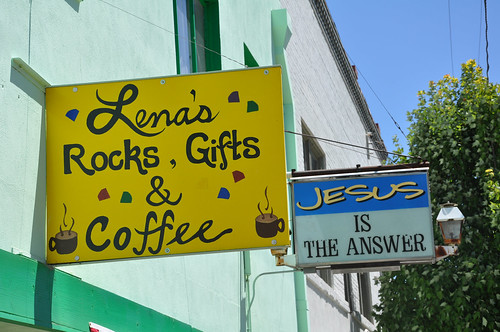
I was taking pictures of the wetsuit and crystals hanging outside a store called “Inspirations” when an unsmiling woman came out and asked why I was photographing her store. I told her about the project and she invited me in.
Inside "Inspirations"
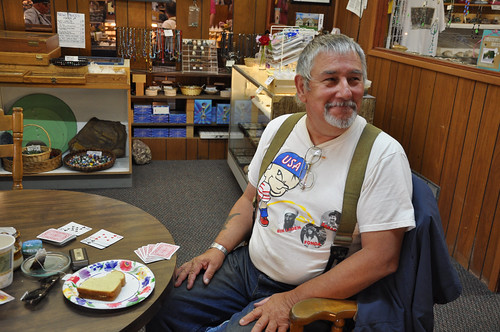
Inside, there were two older men who said they were cheating at gin rummy and eating peanut butter and jelly sandwiches made with Lena’s homemade jam. Inspirations also serviced as a make-shift hang out for the older men of the town.
Lena started talking about how people come to Myrtle Creek to prospect for gold. And the wetsuit outside wasn’t for surfing, but for protecting against the cold water while you’re out there panning.
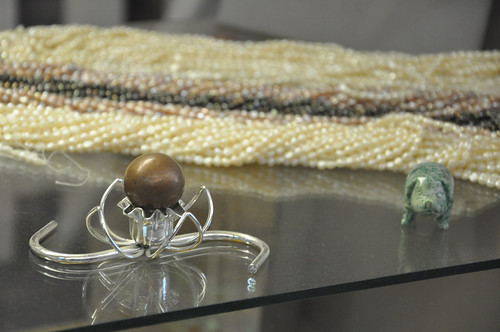
She said that she and her husband had been out there about a year ago and found a huge soccer ball-sized, heavy rock. They thought they’d found gold and sent it in to have analyzed. Instead of gold, it ended up being some kind of gem no one had ever seen before. Since it was totally undiscovered, they got to name it. Their last name is Puls. So they named it Pulsite.
Pulsite
I’m not a prospector or gemologist myself, so I looked a little online to learn more about Pulsite. It seems like there is some debate as to the veracity of Lena’s discovery.
Sometimes when you’re living amidst the numbered blocks and wide avenues of Manhattan it’s hard to imagine that sleepy little towns exist just a borough away. So I enlisted a friend and decided to take the road slightly less traveled (Route 25A) and explore the Main Streets of Long Island’s North Shore.
The convenient thing about 25A is that it winds through towns, often briefly turning into Main Street as you pass through.
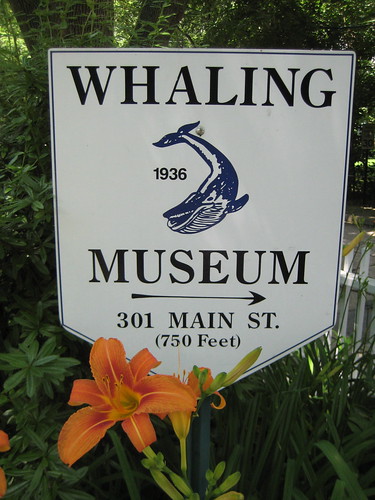
On Main Street in Cold Spring Harbor, there are old houses with chipping paint and plaques boasting construction from the early 1800’s which abut refurbished cottages. Amongst the houses sits Cold Spring Harbor’s Whaling Museum, displaying an old whaling boat and other relics from the town’s fishing days. Richard Timm, the volunteer docent at the Museum, told us that Main Street actually used to be called “Bedlam Street” due to the rowdy drunken fishermen and the mixed tongues of foreign sailors.
Cold Spring Harbor's Whaling Museum
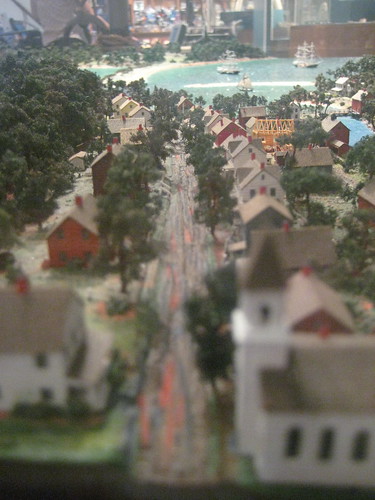
The Whaling Museum, founded in 1936, is surprisingly modern compared to the rest of downtown. T.V. monitors play old videos of fisherman, a light-up screen shows the paths of whale pods across the Atlantic, and a detailed diorama shows Cold Spring Harbor in the mid 19th century, the days of thriving commercial fishing. The tiny Main Street of old is a tree-lined dirt road leading out to the water where the big ships once moored.
A diorama of Old Main street in the Whaling Museum
Richard tells us that though the museum is popular for school groups (16,000 kids came through last year) the walk-in crowd is modest, to say the least. But Richard still enjoys being there. “After all,” he tells me “Whaling is the background of Long Island, the culture, it’s the way Long Island grew up.”
According to Richard, Main Street hasn’t changed much in appearance. But other things have. “I remember towns before shopping malls when every neighborhood had a little shoe store and a penny candy store. My mother never drove to buy food, she walked down the block!”
“Death” he says. “So many places have died.” The towns are trying to bring them back, he says, but it’s tough.
Today my friend and I are the only foot traffic along Cold Spring’s Main Street. A few cars honk, bewildered, as they whiz by on their way to the beach.
Posted in Cold Spring Harbor (NY), Main Street Stories
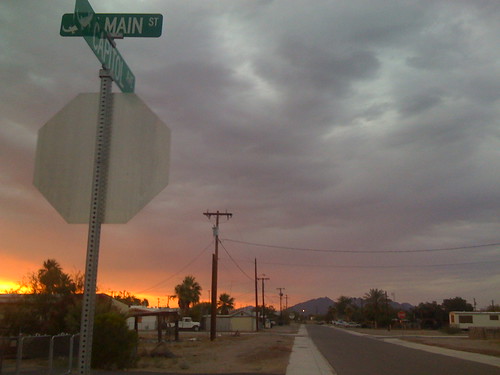
Driving into the sunset on Main Street in Gila Bend, Arizona
Arizona sunsets make you feel like you’re in a movie. After Buckeye, we drive down I-85 south until we hit Gila Bend. I grew up in Phoenix for a bit and my mother still lives there, so there is something about this western landscape that feels normal. Normal that is, in spite of seeing two concrete dinosaurs, a UFO themed hotel (complete with two-story UFO in the parking lot) and a field of old saguaros used as target practice.
We pull off the highway and onto Main Street in Gila Bend.
It’s the abandoned west I love. We drive into a dirt parking lot where “Ben’s Bar” used to be. I assume it was a cowboy bar because of the silhouette of the rodeo rider on the side of the building.
We walk down the street and I pick some creosote so I can bring the smell of desert rain back to New York. There are a few houses on this Main street. We see a man in a cowboy hat standing on his driveway holding his son. We go up and talk to him.
“Hi! What’s going on here?”
His name is Jason and his son’s name is Drason. Jason works for the railroad in Gila Bend, a lot of people who live in Gila Bend do.
“This isn’t much of a Main Street. Just a few houses. There’s a roping arena up the road where people practice once a week, but that’s about it.”
We drive up the road to see if there’s any roping going on. Not right now, although we see a few beer bottles on the ground. There are some horses off in the distance creating the most typical Arizona landscape you could imagine. The only thing missing are the howling coyotes.
We get back into the car and drive off into the sunset.
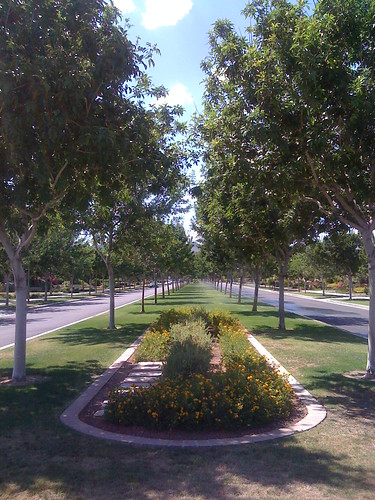
This is what Main Street looks like in Buckeye, Arizona. It’s pretty picturesque, isn’t it? The Main Street in Buckeye is about 25 miles west of downtown Phoenix off of I-10. It’s part of the dreamed filled vision called “Verrado Way.” A place billed by its developers as a neighborhood with “a warm welcoming ambiance and small-town charm. Verrado is a diverse community where you can build your own path to happiness.”
Looks can be deceiving though.
A foreclosed house on Main Street in Buckeye, Arizona.
I drive out Main Street in Buckeye and at first I don’t find anything wrong. Then I get out of my car and see a young man trying to corral two dogs that have escaped their owner’s backyard. These dogs are not friendly. They keep chasing kids on bikes and running after cars. But they have tags, so the mutts belong to someone. Kyle Sweet is the man I meet. He’s down from Boulder where he goes to college and is visiting his mom who lives on Main Street.
“I thought there were a lot of foreclosures on this block?”
“There are. My mom’s had about three different neighbors on both sides of her and she moved here only a few months ago. She got a great deal on her house. The foreclosure rate is really high here. ”
We continue to walk, talking with a few other people trying to figure out what to do about these damn dogs roaming Main Street. We can’t seem to get close to them. Eventually someone calls up the home owner’s association to see if they can get animal control out here.
Kevin and I continue to walk and we soon realize that there are more empty houses than we had thought.
“The thing you have to do is look at the grass.”
Once the ground is brown, the house is empty. A foreclosed home on Main Street in Buckeye, Arizona.
Brown grass = empty house. Even if they don’t have signs. Even if they look beautiful.
“It’s worse that it looks. Everything is hidden here.”
Kyle and I walk up and down Main Street looking for brown grass, the walk up to the homes to see if they’re empty. I’m surprised by each vacant home. They look like palaces. There are so many houses on this Main Street that are empty, I lose count after a while. It’s like a Disneyland Ghost Town.
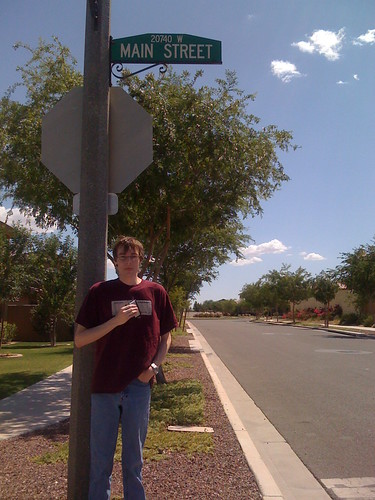
I make Kyle stand by a Main Street sign and take his picture.
Kyle Sweet, my Main Street Buckeye tour guide, stands by a sign.
After our informal adventure and tour, I get in the car and drive off. I never did find out what happened to those dogs.
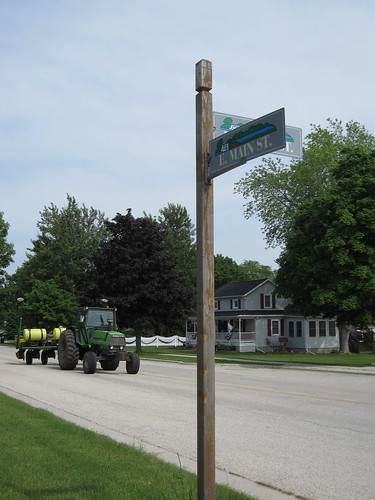
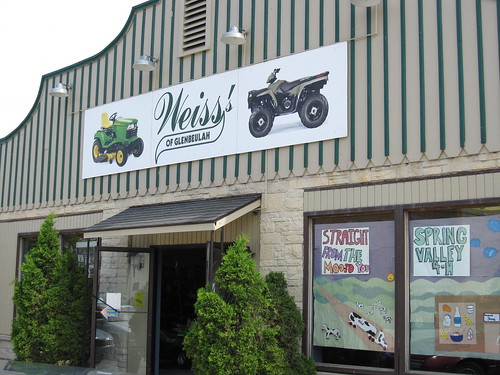
Just a few miles from the resort town of Elkhart Lake is the small town of Glenbeulah, population 378. The Main Street, running right through the center of town, is flanked by a few businesses and houses with empty front porches. I’m there around midday so things look fairly deserted, people off tending to their farms or perhaps working at the nearby resort. I jump out of my car to take a quick picture of the Main street sign just in time to see a massive tractor drive down the center of the street. It’s likely headed to Weiss’s Lawn and Garden, a large storefront with tractors and other farming supplies sitting outside.
Weiss's has been on Main Street since 1946
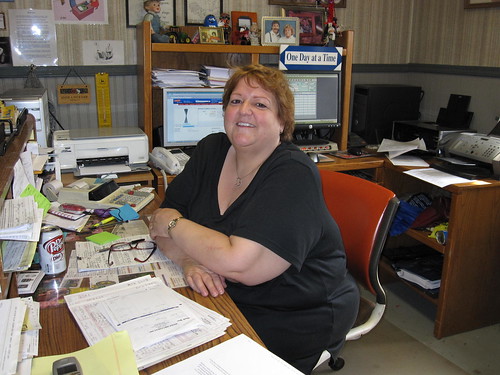
Weiss’s interior is like the floor of a car dealership except the customers come there in search of shiny new John Deeres, not hot rods. In the back office Mary Marciano sits at her computer, placing orders for tractors and other farming items. She tells me she has been working at Weiss’s for 32 years. The business was started by her father in 1946. She’s lived on Main street her whole life, and supposes her family goes back about a hundred years in Glenbeulah. “It’s a small town,” she says “With its quirks like any other town.” Mary tells me that they just put up a subdivision at the other end of Main Street. She used to know everyone in town, but now it’s getting bigger.
Mary has worked at Weiss's for 32 years and lived in Glenbeulah all her life.
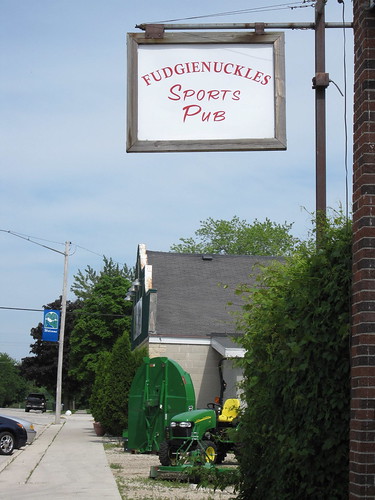
Down the street next to the gas station is Marshall’s gateway, a new-looking mini mart. Mike Miller, the manager, stands at the front counter inside. He tells me that Marshall’s opened about 3 years ago on the empty lot that use to house a metal manufacturing company before it closed down. I ask Mike about the major construction going on next door and he tells me, “Oh that’s going to be the new Fudgienuckles.”
Fudgienuckles?
It turns out the original “Fudgies” was the town bar that burned down a year ago, leaving a big hole in the community, “It was a mainstay on Main Street” he says. I notice a PT Cruiser next to the construction site with a license plate that reads “Fudgies” and nearby a woman in pink authoritatively surveys the site and talks to the constructions workers. I guess she has something to do with Fudgies.
The famous "Fudgies" of Glenbeulah is the mainstay of Main Street
I guess right. Carrie Lewitz is the daughter of the owners of what most people in town called “Ma and Pa Fudgies”. She tells me about the day it burned down. “People were on the street bawling, just bawling.” Fudgies was clearly more than just a bar. “On Christmas we’d have a Santa Clause who really looked like Santa Clause. And Halloween we’d have a basket of candy for the kids. It was family oriented.” But things are looking good with construction and Carrie is confident it will be finished by August. “They always knew they’d rebuild, I mean there’s only one Fudgies” Carrie says with a laugh. Karen Hefter, who lives nextdoor to the old Fudgies site tells me “We just want our bar back.” Fudgies is something of a community center in Glenbeulah – a place to gather and bring the family, see familiar faces, and shake Ma and Pa Fudgie’s hand when you walk in the door. Carrie says, rather wistfully “Small towns are cool, they really are.”
Outside the temporary "Fudgies." The original Fudgies that burned down last year, is due to be rebuilt by August.
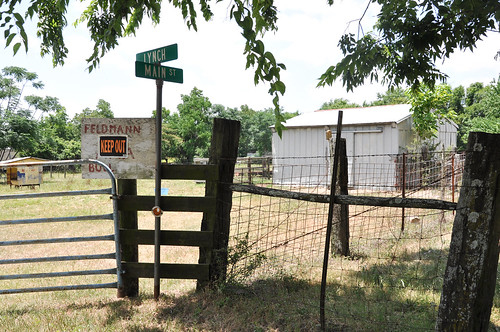
Main Street in the middle of a field in Navasota, TX
As we pulled into Navasota, TX Case and I were really excited. Looking at the map, it appeared to be very un-Main Street type Main Street. Very far from downtown.
When we arrived, we were not disappointed. It was a one-block, one-lane gravel road on the edge of a field. It was so small there weren’t even any driveways off of it. It sort of felt like it was in everyone’s backyards.
While we were out there taking photos and taking the opportunity to jump a little rope, a man Terry Collins walked up to us. He grew up in Navasota. He said it was a pretty safe town. Not too many gangs.
When we told Terry what we were up to, that we were documenting Main Streets across the country he said, “Hmmm. I don’t think Navasota has a Main Street.”
I told him “This street is Main Street!”
He thought I was joking until I showed him the sign at the end of the gravel road.
This is a great book that came out last year on the 1930s New Deal program “Modernize Main Street.”
Synopsis from University of Chicago Press:
An important part of the New Deal, the Modernization Credit Plan helped transform urban business districts and small-town commercial strips across 1930s America, but it has since been almost completely forgotten. In Modernizing Main Street, Gabrielle Esperdy uncovers the cultural history of the hundreds of thousands of modernized storefronts that resulted from the little-known federal provision that made billions of dollars available to shop owners who wanted to update their facades.
Esperdy argues that these updated storefronts served a range of complex purposes, such as stimulating public consumption, extending the New Deal’s influence, reviving a stagnant construction industry, and introducing European modernist design to the everyday landscape. She goes on to show that these diverse roles are inseparable, woven together not only by the crisis of the Depression, but also by the pressures of bourgeoning consumerism. As the decade’s two major cultural forces, Esperdy concludes, consumerism and the Depression transformed the storefront from a seemingly insignificant element of the built environment into a potent site for the physical and rhetorical staging of recovery and progress.